

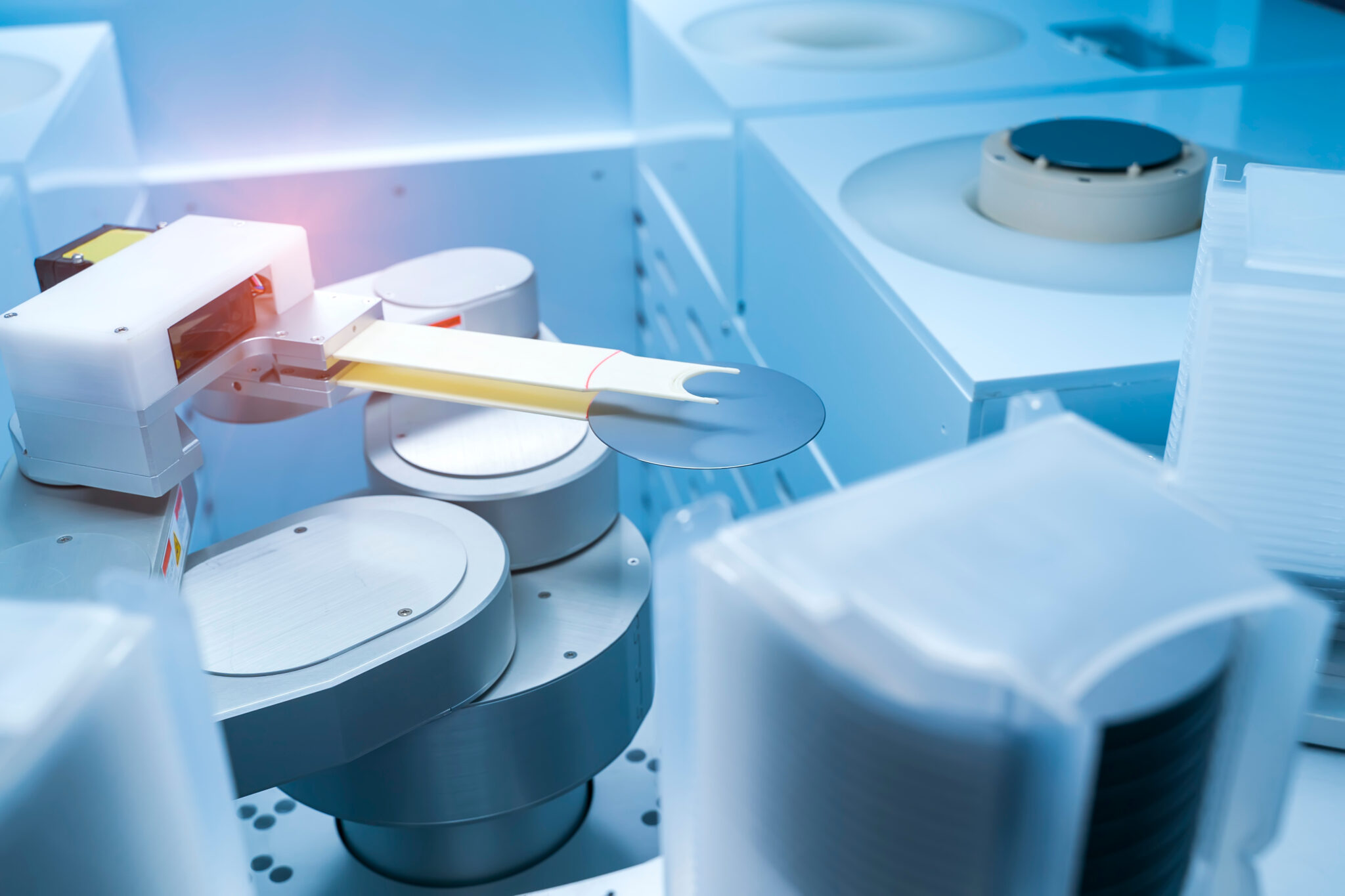
Separating two surfaces that were in contact leaves both charged. In a fab that happens at every wafer transfer, every carrier dock and every robot pick, which makes it a standing condition of the process.
Charge affects deposition twice over. It pulls particles toward a surface, and it holds them there once they arrive.
How much that matters depends on particle size, and the size range a modern fab cares about is the range where it matters most.
Settling, diffusion and electrostatic attraction
Gravity dominates deposition for large particles and falls away quickly as particles get smaller. Stokes settling velocity scales with the square of diameter, and the Cunningham slip correction offsets that only partly at submicron sizes. For unit density spheres in still air at 20 °C the numbers look like this.
| Particle diameter | Settling velocity | Time to fall 10 mm |
| 5.0 µm | 2,800 mm/h | 13 seconds |
| 1.0 µm | 127 mm/h | 4.7 minutes |
| 0.5 µm | 36 mm/h | 17 minutes |
| 0.3 µm | 15 mm/h | 39 minutes |
| 0.1 µm | 3.2 mm/h | 3.2 hours |
A 5 micrometer particle settles close to three meters an hour. A 0.1 micrometer particle settles about three millimeters an hour, roughly 900 times slower, and slow enough that gravity stops being what carries it to a surface. What carries it instead is Brownian diffusion and, where a surface holds charge, electrostatic attraction.
The electrostatic contribution does not reduce to a single figure the way settling does. It depends on the charge on the particle, the charge on the surface and the field between them, and all three vary by location and by what has been handled recently. That is a real limit on this argument and worth stating plainly. The settling velocities above are calculable from first principles. The comparison against electrostatic deposition is not, at least not without measuring charge in your own process.
What the table does establish is direction. Below roughly half a micrometer the mechanism that used to dominate has become negligible, and one of the mechanisms replacing it is controllable.
Conditions that hold charge
Insulating materials hold charge instead of dissipating it. Low humidity, common in process areas, slows dissipation further. A surface with no path to ground has no way to shed what it accumulates.
People belong on that list. Synthetic cleanroom garments charge readily as an operator moves, and the charge travels with them to whatever they handle next.
Charge also changes what happens after a particle lands. A particle held electrostatically sits tighter against the surface than one that settled there, so it survives the next clean more often. A charge problem can therefore show up as more particles arriving and more of them staying, which are two separate costs on the same defect budget.
None of this has to be inferred from deposition results. Surface voltage is measured directly with a static field meter, and that is a faster check than working backwards from a defect map.
ISO 14644-17 and electrical potential
ISO 14644-17:2021 covers the measurement of particle deposition rate. Clause 6 asks that a witness surface sit in the same plane as the vulnerable surface, as close to it as possible, and at the same electrical potential.
That last condition is the interesting one.
A witness surface at a different potential from the wafer it stands in for will collect a different number of particles, so the measurement ends up describing the coupon instead of the wafer. The condition is in the standard because charge changes deposition, which means the committee treated the effect as large enough to invalidate a result when it is ignored.
The same standard reports deposition as a rate over a known area and exposure time. That is what makes one location comparable with another.
Controls
Grounding comes first. Conductive and dissipative materials with a real path to ground shed charge instead of holding it, and that applies to work surfaces, fixtures, carriers and tooling as much as to the people handling them.
Ionization covers what grounding cannot reach. An insulating surface has no useful path to ground, so an ionizer neutralizes the charge in place. Placement matters, and so does periodic verification, because an ionizer drifting out of balance will leave a surface charged in the opposite direction.
Humidity and material selection also contribute. Higher relative humidity helps charge dissipate, though process requirements usually set that number before contamination control gets a say. Material choice is the more practical lever, particularly for carriers, trays and anything that contacts a wafer.
Whichever controls are in place, they need a verification schedule. Grounding paths fail and ionizer emitters foul, and neither failure announces itself in a particle count.
Airborne counts and deposition
Airborne particle counts describe the air that was sampled. They carry nothing about how much of that population is being pulled onto a charged surface, so two locations can report identical counts and deposit very differently.
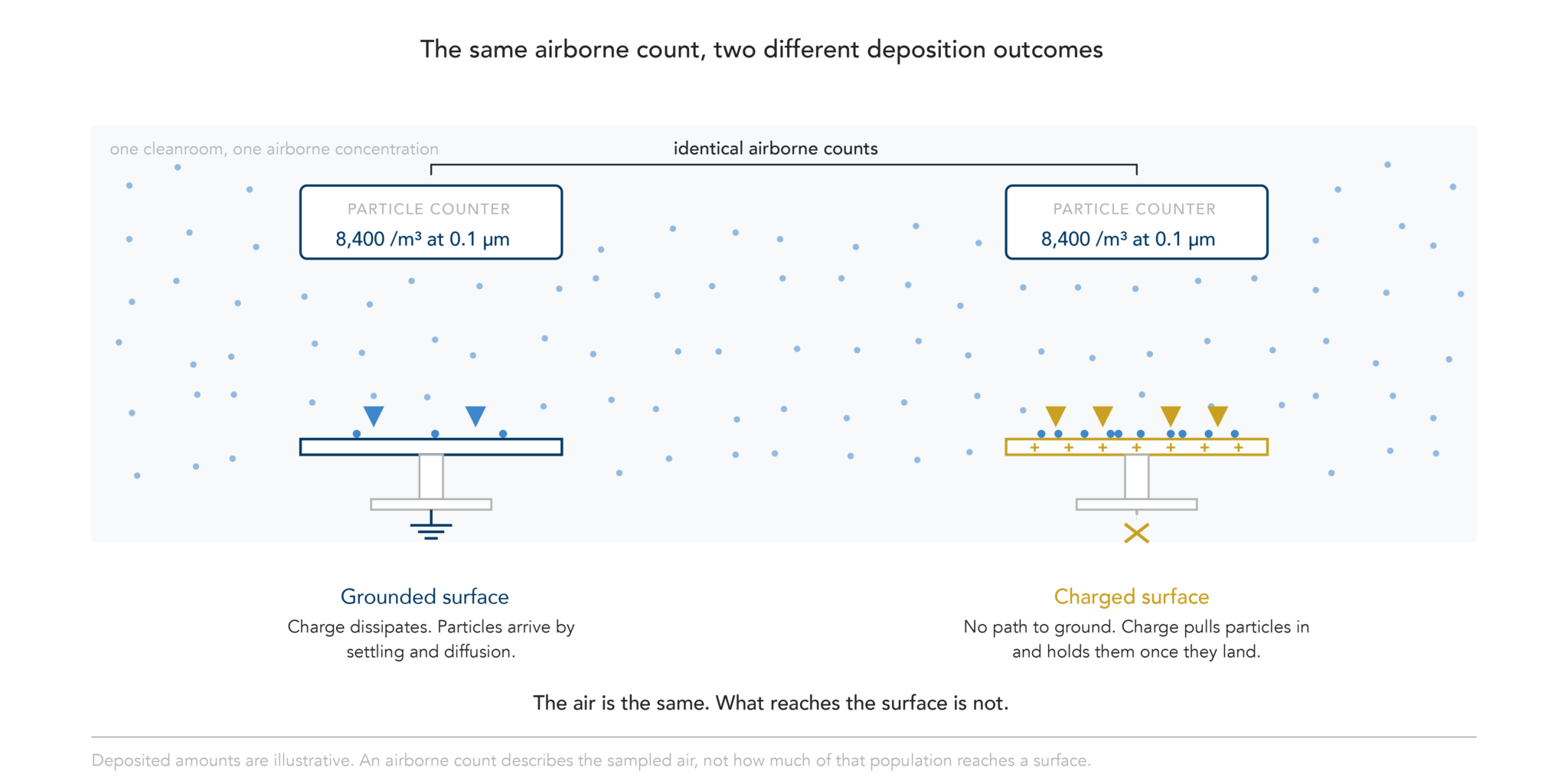
That is one route to a location passing routine monitoring while defects climb. Closing the gap takes deposition rate measurement or surface evidence, which we cover in our guide to particle deposition.
Lighthouse Worldwide Solutions® (LWS) makes airborne particle counters rather than static control equipment, so none of the controls above are ours to sell. The measurement side is where we can help. Where charge is suspected, comparing airborne counts across locations is an inexpensive first step before committing to a deposition study, and a portable counter is the usual instrument for that kind of survey. Our ApexZ is built for it.
Working out where charge could be affecting your deposition numbers? Contact us today and we will go through it with you.
References
ISO 14644-17:2021, Particle deposition rate applications. iso.org/standard/70606
W C Hinds, Aerosol Technology: Properties, Behavior, and Measurement of Airborne Particles, 2nd edition, Wiley, 1999. Settling velocities calculated from Stokes law with the Cunningham slip correction.
W Whyte, K Agricola and M Derks, Airborne particle deposition in cleanrooms: deposition mechanisms. Clean Air and Containment Review, Issue 24, October 2015.